
The Science Behind Immersive Motion Simulations and What You Need to Know
In the world of entertainment, nothing compares to the thrill of stepping into a completely immersive experience. From soaring through the skies in a fighter jet to racing on a high-speed track, motion simulations have revolutionized the way we experience adventure. But how do these high-octane experiences actually work? What makes it possible to feel like you’re skydiving or riding a bike off-road—without ever leaving the ground?
At Simraw, we believe in giving you the most realistic, heart-pounding simulations possible. But to truly understand how we make this magic happen, let’s take a deep dive into the science behind immersive motion simulations.
1. The Foundation: Motion Sensing and Feedback
At the core of immersive motion simulations is motion sensing—the technology that allows users to feel like they’re moving even though they’re stationary. This process is built on several key principles:
-
- Gyroscopes and Accelerometers: These sensors are used to track the motion of the simulation platform. In motion simulators, they detect changes in orientation, acceleration, and angular velocity. For instance, in a flight simulator, these sensors track the plane’s movement, like banking and tilting, and translate that into a physical experience for the user.
-
- Force Feedback Mechanisms: These systems provide realistic tactile responses to the user. When you’re flying a jet in the Jet PIT, for example, the motion system will simulate the force you’d feel during sharp turns or rapid ascents, creating an authentic experience of G-forces, acceleration, and deceleration.
These motion-sensing systems work together to create movements that closely mirror real-world experiences—allowing your body to feel what your eyes are seeing. By using these sensors, immersive simulations can recreate the physical sensation of movements like acceleration, braking, and turning, making the experience incredibly lifelike.
2. Visual and Audio Integration: Engaging the Senses
While motion is a key part of the experience, visuals and audio play just as significant a role in making simulations feel authentic. Our brains are highly responsive to both visual stimuli and sound, and when these elements are perfectly synchronized, they enhance the realism of the experience.
-
- High-Resolution Visuals: To simulate real-life environments, our motion simulations use high-definition screens or even panoramic displays that immerse the user in a 360-degree world. Whether you’re zooming down a race track or flying through the clouds, the visuals are designed to make it feel as though you are truly there.
-
- Spatial Audio: Realistic audio is crucial for tricking your brain into believing you’re actually in the environment. When you’re free-falling in the Dive PIT, you’ll hear the rush of wind, the swoosh of air as you descend, and the faint hum of machinery. Audio cues such as the roar of an engine, the sound of wind rushing past, or the feedback from explosions further enhance the sense of immersion.
When the visuals, sound, and motion work together, they create a multisensory experience that feels shockingly real.
3. The Role of Human Perception: How We Trick the Brain
Our brains are incredible at processing information from our senses, and motion simulations take full advantage of this ability. By carefully manipulating the sensory feedback provided by the simulation, we trick the brain into believing that the experience is real. Here’s how it works:
-
- Visual-Vestibular Conflict: Normally, when you move, your eyes and inner ear (the vestibular system) provide similar signals to the brain. However, in motion simulations, the body remains still while the eyes are tricked into believing movement is happening. This creates a phenomenon called the visual-vestibular conflict, which gives you the sensation of motion and accelerates the body’s response. For example, if you’re flying in the Flight PIT, your eyes perceive the change in altitude and movement, while your inner ear doesn’t feel the corresponding motion. This conflict adds to the realism and sensation of motion.
-
- Proprioception: This is the body’s ability to sense its position in space. In simulations, platforms are designed to move in sync with the motions of the experience, allowing your body to react to shifts in position, tilts, and movements. So, when you make a sharp turn in the Racer PIT, your body will tilt and shift in real-time, amplifying the feeling that you’re in the driver’s seat.
-
- Psychological Perception: The human mind is remarkably adaptable, and once it is introduced to these virtual realities, it begins to accept the simulation as real. Your brain processes these sensory cues and fills in the gaps, allowing you to experience the adventure as though it were happening in the physical world.
4. The Future of Motion Simulation: Enhancing Realism
While we’ve made impressive strides in motion simulation, the future holds even more exciting developments. Here’s what we can expect next:
-
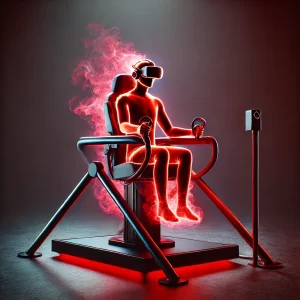
- Full-Body Simulations: The next frontier in motion simulations includes incorporating full-body suits or haptic feedback devices that enhance the physical sensations of touch and force. Imagine feeling the vibration of a car’s engine or the sensation of wind against your face while you’re biking in the Biker PIT.
-
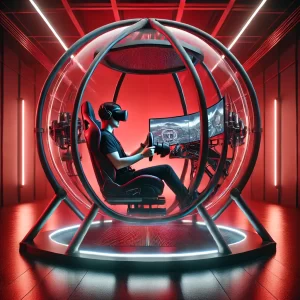
- Virtual Reality (VR) Integration: Combining VR with motion simulators could take the sense of immersion even further. VR headsets will allow you to look around in every direction, while motion platforms provide the physical sensations to match. The combination of VR and motion will create experiences that feel indistinguishable from reality.
-
- Advanced Biometric Feedback: The future may also bring systems that monitor your heart rate, breathing, and other biometric factors, adjusting the simulation to match your emotional state. For example, if your heart rate increases during a high-speed race or a near-miss in the War PIT, the system could ramp up the intensity to keep your adrenaline pumping.
Conclusion: Why Immersive Simulations Are More Than Just Entertainment
The science behind immersive motion simulations is all about creating a lifelike experience that engages multiple senses and tricks the brain into believing it’s in the middle of a thrilling adventure. Through motion sensors, visual cues, and sound, simulations at places like Simraw take entertainment to new heights, offering experiences that are truly out of this world.
Whether you’re skydiving, racing, or flying a jet, these simulations aren’t just about excitement—they’re about creating memories, pushing limits, and offering a glimpse into the future of interactive entertainment.
Ready to experience the science for yourself? Visit us at Simraw and step into a world where technology, thrill, and reality collide!